

I was drawing late one night and I happened to look over to my left at
the table with my art supplies that sits next to my light table. My actual art supplies for
the last 25+ years have mostly been the same. As all artists do, we pick
out what we like and keep using it throughout our careers (as long as
they keep making it) and I find myself sometimes apprehensive to trying
something new. If something works for you, why change?
Over the years, I've distilled a lot of my working process down to make
it simpler and between the work being more digital than physical
nowadays I have found myself using a real short list of items to draw
with. I've been asked before what I use to draw so for those interested,
here's the list with pics. From the first pic on top you can see that
my regular tools only take up about a third of the table top in total.

1) PAPER - Mostly I've been using copy paper sized at 8.5" x 11" or the
11" x 17" size for bigger sketches (like comic book pages). Even my
final art for Scooby-Doo (for the comic books at least) have been draw
on normal copy paper. It's cheap and works well. Probably not great for
the archival or collector mentality but it's the raw material to get a
project done. I buy one box with reams of paper in it at Staples once a
year or so. For bigger paper, I buy a ream of it when I
need it. I can burn through letterhead paper with roughs and thumbnails
and if I screw up I grab another sheet real quick from underneath my
light table and continue on.
For final art that I want to have a slick, professional look to it, and
it may be a piece that I'll be selling later on, I use the Borden and
Riley #234 Paris Bleedproof paper for pens. It comes it many sizes and
prices can vary depending on where you buy it. I have to order it online as no local art stores exist or the ones that do don't carry it. Go figure. I like this particular kind of paper as
it's light and thin, easy to work with on the light table, and also
works extremely well with the pens that I ink with. I've rarely had any
bad moments with the paper in terms of smudging and bleeding. Sometimes
things happen but overall this paper works fantastic. It's been my
"go-to" for many years. When I did comics I also would prefer to use
this paper over the company's art board. The quality of paper is lacking
of late there and I'd rather use my own. If I did a cover for DC Comics, I'd use their art board as the people who buy original
art prefer it to be drawn on the "official" board. That is changing though.

2) PENCILS - I can use anything really though I seem to gravitate to a 5H lead for breaking it down and keeping it clean and then a 2H or an HB to bring out the details. Depends on my mood. Sometimes I'll pull out a purple ColErase pencil or even a ball point pen and do the whole deal. At this creative point in drawing, it's about mood and getting it onto the page. You can tweak it later on with another piece of paper. If I do a convention or I'm on the road, I tend to use the 5H and HB.

3) ERASERS - I have three. A kneaded eraser, which is one that I use most often. You can bend and shape it to get into tiny corners and every artists uses one. You can't be a true artist without one! Next is a Staedtler Mars Plastic Eraser, which is great for really cleaning up with as it leaves very little residue or crumbs and does a better job of overall cleaning than the kneaded eraser. My third eraser is a yellow gum eraser, which I use the least and it does a good job at times but leaves a lot of crumbs in its wake.
The Staedtler Mars eraser
is also useful for other things as well, such as when you take the price
sticker off an item you bought and there's some sticky residue left over. The gum eraser sometimes does the job, but a Staedtler
Mars one works superb at taking off the residue without hurting a book
cover or toy box. A Sandford 'Magic Rub' eraser is great too!

4) MICRON PENS - My main stay for 24 years now. I came to using these
mostly after I had to trash a TON of Scooby and other work back in 2001
or so. I used to work with Le Pen, which was a superb pen marker that
worked supremely well on Garde Silk paper which was very smooth. The Le
Pen would glide across the paper and leave such a clean line that it
almost gave the look that you did it digitally. It was great for style
guide work as well where you needed strong clean lines that held up even
when it was enlarged. But then you had the downside... All the work
would fade from black to brown to light brown to almost invisible. It
was great in terms of producing high quality work but the worst in
creating original artwork that you wanted to last. It
would in some cases start fading in one year depending on where you
stored the original art. Hence, I lost a LOT of original artwork that I
had to trash as it was faded and would be hard to sell. Live and learn.
So I started using these Sakura Micron Pens in early 2002 or so and I've
been using them ever since. The ink has never failed me nor faded over
the years as they have archival ink in them. You can go through them
though as keeping the points sharp can be a chore. I use the .005, .01.
.02, .03. .05. and .08. I seem to use the .01 for fine work and the .08
for thicker lines most of the time. I use the others accordingly to what
I'm doing. If I do a convention and I'm doing sketches there, I use
these pens for doing a fast ink job over top of the pencil rough.
From my time at conventions, I found that a lot of artists use them!

5) PITT BRUSH MARKER - My main inking tool for doing sketches, final art, and larger pieces for the last 22+ years. The ink is solid, archival, and the brush points while delicate leaves a nice strong line. It takes some skill and practice to use it right without destroying it. I usually use the frayed brushes (that are no longer useful for fine inking work) to fill in large solid black areas of a composition as well.
Sakura, who makes the Micron Pens I talked about, also makes a brush pen called the Sakura Brush Pen! I used to use that brush mostly in the beginning. It has a finer point to it and takes a while longer to master. I'm not sure why I stopped using it and went with the PITT Brush Marker instead. It may have been because I like the shorter brush that the PITT had and it was easier to maneuver around. They are still superb brush markers, but I think my hand has grown too comfortable with the PITT.


Also, the PITT has an upside that the Sakura Brush Pens don't have. Once they become a bit frayed (and you'll know it when it happens) and don't give you the ink line you want you can take some tweezers and pull out the brush point from the pen tip and flip it around! As you can see from my pics, you have a perfectly good NEW point now to use by simply flipping the brush and sticking it back in. The hard part is leaving the right amount of brush length exposed though. The further out it is, the more control it takes to use. The further you stick it in, the tighter your control will be.

Another trick is that you can twist the end cap off of the pen (sometimes it's hard to do!) and then drop a few drops of ink in from an eyedropper if the PITT Brush is dying on you. Now the only problem with this is that the ink doesn't match. This can be an issue for some but if you are doing convention sketches or roughs with it, it won't matter. I've not used India Ink in so many years that I can't tell you if it's still any good or not. Most artists I know complain about it being watered down or not black enough. Quality control is lacking with India Ink so you might be able to find something you like. At any rate, this is a good little trick to getting the most from your PITT Brush Marker before you have to throw it out.
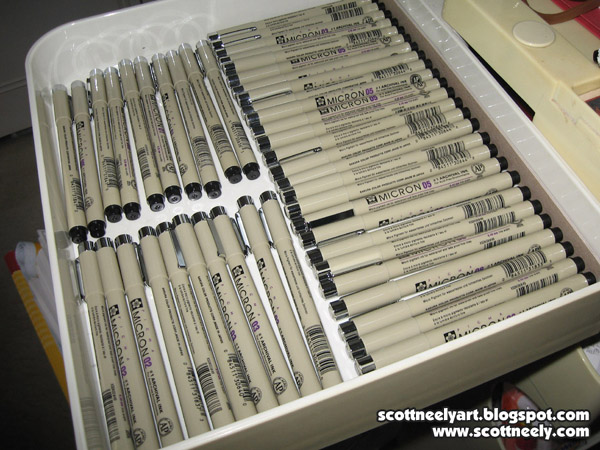

BUY THE STUFF YOU LIKE IN QUANTITY - I only mention this as it's cheaper! If you buy them at three pens at a time, you are spending more money on them in the long run. I go to Dick Blick's Art Supplies on the Internet and buy them by the box. The pens I use come 12 to a box and you can store them away. As you can see from the pics above, I keep extras close at hand on the right side of my light table in the first drawer of my artist's shelf. I lay them out according to size so that I know what I'm reaching for even when I'm not looking. When you have gaps that show up from pens dying out you know which ones to replace and which ones you use the most. You keep a bunch of them in stock so that you can keep working straight through. If you're on a deadline, it takes time out of your day to drive to an art store that carries them and you wind of paying more in some cases. Microns are pricey these days too! Buy them in bulk or if they're on sale. I buy more of the .08 Micron Pens than I do the others as I tend to use them for quite a lot of things like signing books.


6) RULER - My little plastic ruler has been with me for 15 years at least! It was cheap and did the job. It was clear plastic as well so it makes working with easier. The downside is that it had no lip or inking edge to it so if you ran a brush or marker next to it chances are you'd create a smudge when you pulled the ruler away. This happened a lot, so I got the idea of raising it off the paper by taking a piece of thin cardboard and cutting it so that it fit underneath the ruler and left an inking edge on both sides. I added a little piece of tape to hold it into place on either end of the ruler and it was my "go-to" ruler for a decade. They are cheap and easy to replace. I do have two other bigger rulers that I use for doing longer lines naturally, but this little one gets me through all the details!

7) FRENCH CURVES - Ah, the tool of the Jedi. If you are well trained in using a French curve they will serve you well, young padawan. I have many here of different shapes and sizes but I use basically three different ones. One of them (pictured above) has an inking edge built in. If you can buy them this way, make sure you do. It makes life easier! Otherwise...

You have this kind of French curve where I had to do the same thing that I did to my ruler and tape some cardboard to the bottom of it to raise it up off the paper. I use the outer edges mostly for bigger, wider curves. It's my second "most used" French curve.
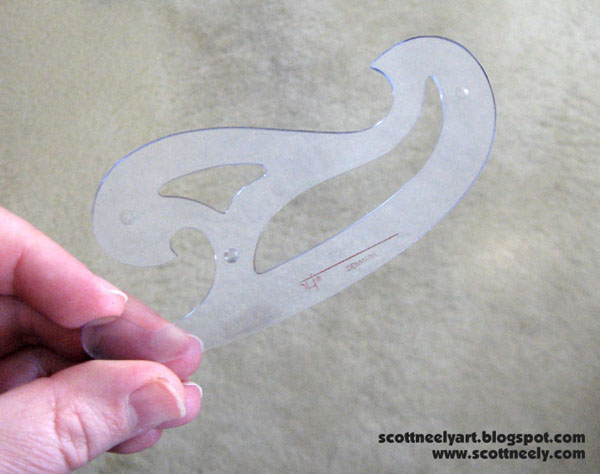
And the third is my little worn and faded French curve. It's been with
me now for over 30 years or longer and we've been through many, many jobs over
the years together. I got it back when I was in high school when I was
taking mechanical drawing. It has never failed me! I've used it so much over the years that it's
like a Swiss-pocket knife for me in terms of working. I use a side here
and a curve there, and maybe a little piece here and there. Over time, you learn to wield it
like a blade and you know how to use it with your pencils and pens. It's why it sits on my table
where it does. I haven't bought another one since so I have no idea what
these small ones cost nowadays.
This, of course, is all based on my years of doing art and what I feel
most comfortable drawing with to get the best results. It's up to you to
try and experiment with the many supplies out there to see what works
for you! Buy the supplies that feel good in your hand and give you the
best results... and then buy a lot of it in case they stop making it!


%20TV%20Show_Baby%20Dinosaur_1993%20Conte%20Crayon%20Sketch.jpg)


